Smart Cities & Pandemics
Over the past few months we have seen the worst pandemic outbreak of a disease that we have witnessed in recent times. COVID-19 has drastically changed the way that many of us live our day to day lives including; school, work, recreational activities, and even health care. There has been an extreme focus on social distancing to reduce the spread of COVID-19 and ease the stress on our healthcare system, but a lot of people just aren't very content with just staying at home, not working, and not interacting with other people. Recently we have started to see protests over stay at home orders, with those protesting claiming that forcing American citizens to stay at home is non-constitutional and a violation of their rights.
Another issue that has been brought up recently has been how a lot of our developed countries are actually lacking the medical infrastructure to deal with a pandemic. A lot of developed countries have been struggling to deal with the dramatic influx of patients that they have been receiving in their hospitals and the limited resources a lot of them had on hand to deal with a pandemic such as this. Hospitals have gone as far as stopping all non-urgent procedures and care to free up as many resources as possible for corona patients. This has produced a lot of issues for people who may need care and have been denied care and have suffered/died as a result. We've been hearing more and more stories of people being denied cared at various facilities and turning up dead in the next couple of weeks because they were denied from multiple emergencies rooms at the time they requested help.
 |
| As tensions hold, more countries are starting to test for fevers before allowing to travel or enter certain places. |
The way cities and work culture will likely change in the future is related to how they will be designed in a way to allow them to be more social distance by design whether it be restaurants, movies, other businesses, or public spaces. A lot of businesses have already proven that they are capable of running completely out of office remotely as businesses look to increase social distancing, this begs the question of do we actually need most people to drive into work? City transportation infrastructure is largely related to work commuting, but if people no longer have to commute as we've been proving that commuting to on campus work sites is kind of unnecessary, and if companies continue with social distancing practices we could actually see reduced commuter traffic in general.

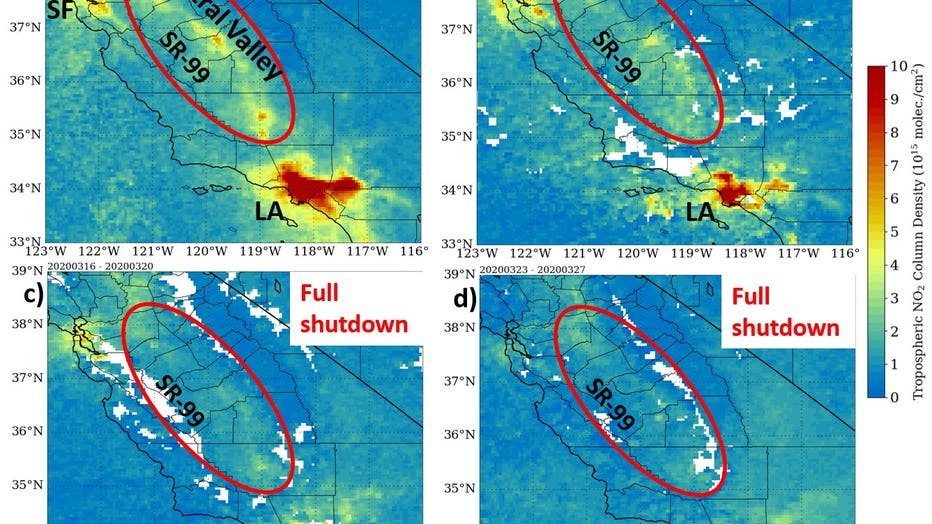
This change in consumer and work culture in general will greatly change the way that people commute, spend money, and even go out. It will change the way that restaurants and businesses are laid out to allow people to keep as much space as possible and potentially comply with future social distancing pandemic regulations, so that they can continue providing service more freely during future incidents. Work culture will also probably transition a bit more towards come in only as needed basis, with more people working remotely as much as possible. This will have significant impact especially on city transportation systems including roads, trains, buses, and other transit options if they are now just being used less. Among the positives we have seen NO2 levels around cities and major roadways have drastically dropped as our environmental impact has been reduced as people are just doing less overall. Below we can see the effect of quarantine orders on California.
How Smart Technology Could Help Us In The Future
One way that a city may change is by implementing smart fever censors at store fronts and transportation hubs to sense when people walk in with high fevers. We could change protocol and make these people sanitize their hands and put on a face mask if they get detected at the entrance. This way we could detect and track potential infectious disease outbreaks before they happen and contain them better by preventing them from traveling long distances or entering places of high human density. This data could also be used to map and track disease outbreaks as well as stop as many cases from spreading as possible, protocol could vary based on current events and situation.
Another smart city solution that may change is allowing an environmental tax breaks for corporations that allow more of their workers to work remotely. When paired with environmental sensors we could offer all opting corporations tax breaks directly linked to the environmental air quality improvement. We have already witnessed multiple nations experience improved environmental qualities over these past few months, and I think we could continue to further that if we continued on a path of less use. These air quality sensors could be used for more than just work from home environmental impact, but could also be used to monitor general air quality and the effects of potential environmental disasters. These sensors could go a long way with monitoring pollution and what a city's impact is on the environment.
A third way we may see cities change are in the way that we handle pandemics isn't necessarily going to be a technological change, but I think we'll see a way that businesses and other public infrastructure is designed. Currently, a lot of our infrastructure doesn't really accommodate for proper social distancing if needed, and as a result a lot of businesses and public places have been closed to visits completely. I think a lot of businesses have and will continue to implement proper spacing/room to allow patrons to social distance and keep work areas more divided from patron areas to further protect workers from infectious diseases. I think even if these measures aren't up 24/7 a lot of businesses and local areas will probably have very clear and thought out procedure of how to respond in a timely manor in future pandemics.
WORKS CITED:
1. https://kinder.rice.edu/urbanedge/2020/03/26/what-our-cities-will-lookafter-coronavirus-pandemic
2. https://www.theguardian.com/world/2020/mar/26/life-after-coronaviruspandemic-change-world
3. https://www.citylab.com/equity/2020/03/coronavirus-cities-adapt-futureplan-economy-infrastructure/608908/
4. https://calmatters.org/commentary/with-coronavirus-we-should-practice-physical-distancing-not-social-distancing/ (image social distancing)
5. https://www.commondreams.org/sites/default/files/styles/cd_large/public/headlines/italy_coronavirus.jpg?itok=edGdWIMA (image tempchecks)
6. https://images.foxtv.com/static.fox29.com/www.fox29.com/content/uploads/2020/04/932/524/no2-california-nasa.jpg?ve=1&tl=1 (image N02 decrease California)
